 by
by Many families want to transfer parents property to children in Kerala while the parents are still alive, so that there are no disputes later. Others need to do it after the parents pass away. Kerala law gives several clear ways to do this, such as a settlement deed, gift deed, Will, partition deed or inheritance. This guide explains each option, documents, costs and the full process, including registration and mutation (pokkuvaravu).
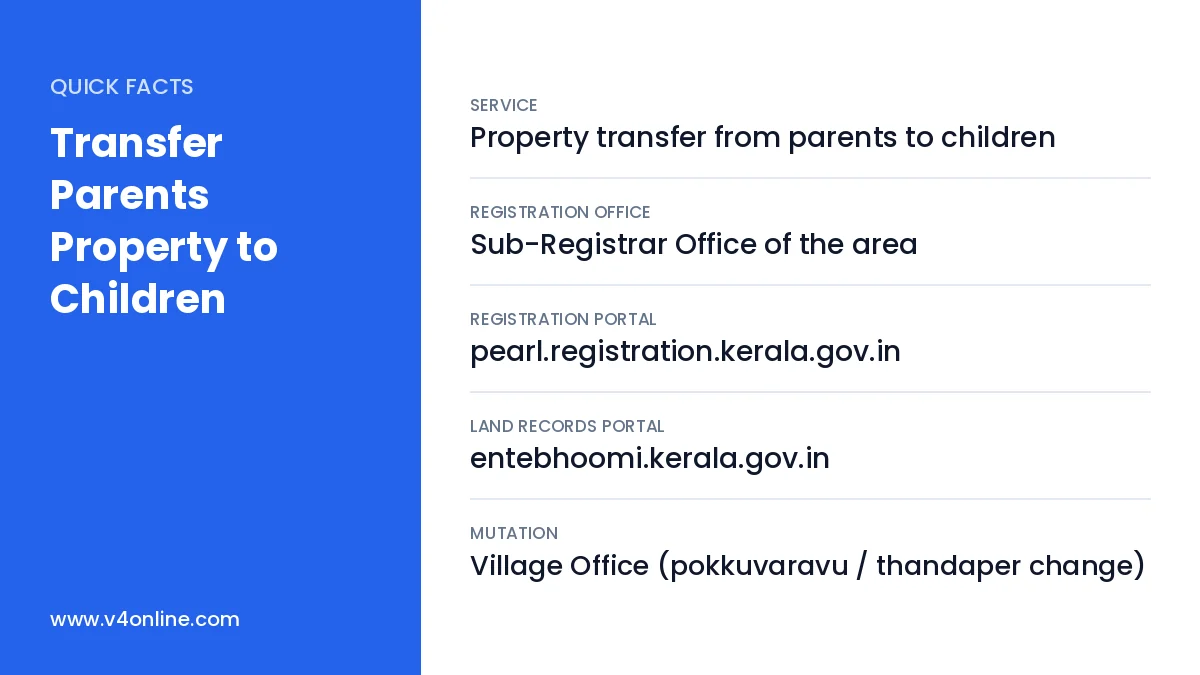
| Service | Property transfer from parents to children |
|---|---|
| Registration Office | Sub-Registrar Office of the area |
| Registration Portal | pearl.registration.kerala.gov.in |
| Land Records Portal | entebhoomi.kerala.gov.in |
| Mutation | Village Office (pokkuvaravu / thandaper change) |
Ways to Transfer Parents Property to Children in Kerala
- Settlement Deed (Dhananischaya Adharam): the most common method in Kerala. Parents transfer property to children with love and affection, and can keep a life interest for themselves.
- Gift Deed (Danadharam): a transfer without payment that takes effect immediately after registration.
- Will (Ossiyathu): takes effect only after the parent’s death and can be changed any time before that.
- Partition Deed (Bhagapatram): used when property is divided among several children, usually after the parents’ death.
- Release Deed (Ozhivukuri): used when one heir gives up their share in favour of another.
Best Method to Transfer Parents Property to Children
If the parents want to transfer property now but continue living in the house, a settlement deed with a life-interest clause is usually the best choice. A gift deed suits cases where immediate ownership is intended. A Will costs almost nothing, but works only after death and can be challenged. When there is no Will, the property passes to the legal heirs under the applicable succession law, and a partition deed is then used to divide it clearly.
Documents Required to Transfer Parents Property to Children
- Original title deed (adharam) and previous title documents of the property.
- Latest land tax receipt and thandaper (possession certificate if requested).
- Encumbrance certificate (EC) to confirm there are no loans or claims.
- Survey number details, location sketch or digital sketch where applicable.
- Aadhaar and PAN cards of parents and children, plus passport-size photos.
- For inheritance cases: death certificate and legal heirship certificate.
How to Transfer Parents Property to Children: Step-by-Step
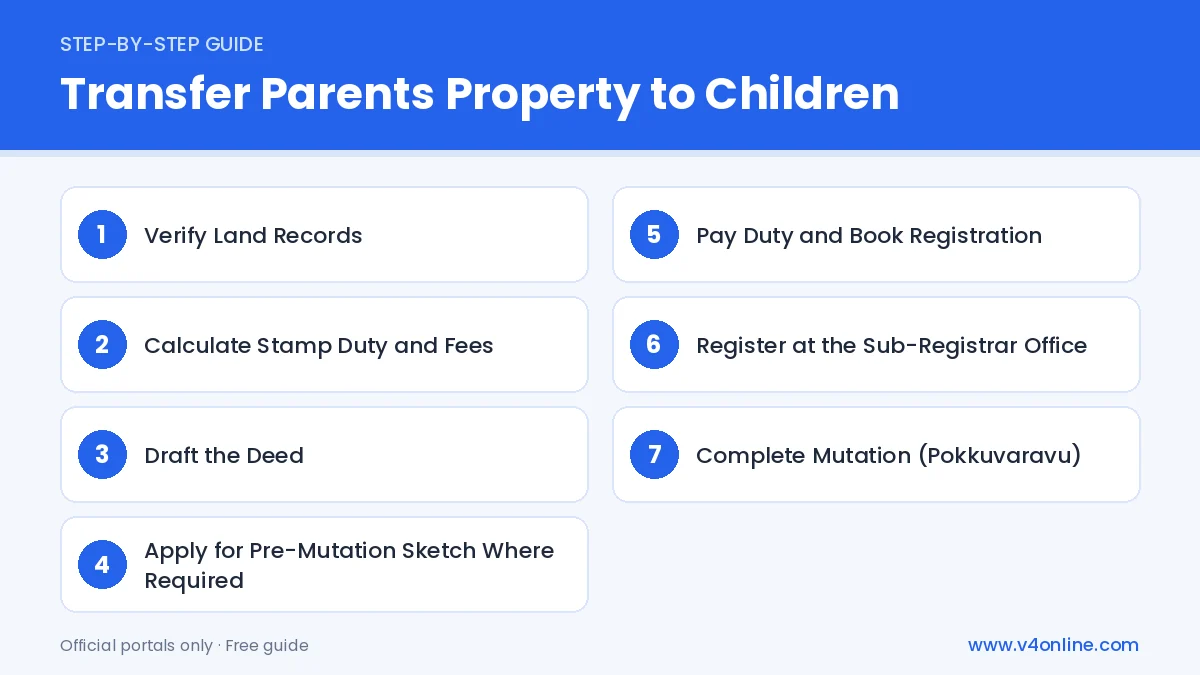
Step 1: Verify Land Records
Check the survey number, thandaper and owner name on the Ente Bhoomi or ReLIS portal. Confirm the property is in the parent’s name with land tax paid and no loan or attachment. Also get an encumbrance certificate to confirm a clean title.
Step 2: Calculate Stamp Duty and Fees
Stamp duty is calculated on the government fair value or market value, whichever is higher. Kerala gives concessional rates for settlement or gift to close family members, far lower than the rate for a sale. Use the fee calculator on the Kerala Registration Department portal to know the exact amount for your document.
Step 3: Draft the Deed
Get the deed drafted by a licensed document writer or advocate. The deed must clearly describe the property with survey number, extent, boundaries and village, and state the names of the parents and children. If parents wish to keep the right to live in the house or receive income, include a life-interest clause.
Step 4: Apply for Pre-Mutation Sketch Where Required
In villages where the digital resurvey is complete, Kerala now requires an online application through the Ente Bhoomi integrated portal before registration. A surveyor prepares the digital sketch and the Village Officer verifies the thandaper. These documents are then linked with the deed at the Sub-Registrar Office.
Step 5: Pay Duty and Book Registration
To transfer parents property to children legally, pay the stamp duty and registration fee online through e-stamping on the registration portal. Book a date at the Sub-Registrar Office where the property is situated.
Step 6: Register at the Sub-Registrar Office
Parents (the executants), the children (claimants) and two witnesses must appear with original ID proofs. The Sub-Registrar verifies identity, records thumb impressions and photos, and registers the document.
Step 7: Complete Mutation (Pokkuvaravu)
After registration, make sure the thandaper is changed to the children’s names at the Village Office and pay land tax in the new name. Check the updated record on Ente Bhoomi. Without mutation, revenue records still show the parents as owners.
Transfer After the Parents’ Death
If the parents have passed away without a Will, the children must first get the death certificate, which can be downloaded as explained in our Kerala death certificate download guide. Next, apply for a legal heirship certificate from the Tahsildar through e-District; see our e District Kerala login guide. With these documents, the heirs can apply for mutation in all their names, and later register a partition deed to divide the property.
Common Mistakes to Avoid
When you transfer parents property to children, never rely on an unregistered or notarised paper; only a registered document is valid. Double check survey numbers and boundaries, involve all legal heirs, and keep certified copies of every document safe.
Frequently Asked Questions
What is the cheapest way to transfer parents property to children?
A Will has almost no cost, but it works only after death. For transfer during lifetime, a settlement deed with concessional family stamp duty is common.
Can parents keep living in the house after transfer?
Yes. A settlement deed can include a life-interest clause for the parents.
Is mutation needed after registration?
Yes. Revenue records must be changed at the Village Office to show the new owner.
Conclusion
To transfer parents property to children in Kerala without future disputes, choose the right document, verify land records, pay the correct stamp duty and register the deed at the Sub-Registrar Office. Complete mutation soon after and pay land tax in the new name. Since every family situation is different, consult a document writer or advocate before signing.